“Wait—those are spider webs?” my niece whispered, pointing at the platter like I’d just pulled off actual witchcraft. Honestly, that moment made my whole Halloween. I’d spent the afternoon testing deviled eggs for our family costume party, trying to find something that looked creepy but still tasted like, well, food people actually want to eat. Not just something pretty that sits there untouched while everyone grabs the chips instead.
These Spooky Spider Web Deviled Eggs were born from that exact challenge. I wanted the wow factor without the stress, and I wanted them to disappear as fast as the candy bowl. The first batch came out looking like abstract art gone wrong—more like a toddler played with a squeeze bottle than a spider web. But by the third try, I cracked it. The trick? A steady hand, the right piping tip, and not overthinking it.
Now they’re my go-to Halloween appetizer. They show up at every spooky gathering I host, and people always ask how I did it. The best part? They’re just regular deviled eggs with a simple decoration on top. No special ingredients, no complicated techniques—just a little patience and a fun idea. If I can make them look this good, honestly, anyone can.
And let me tell you, watching someone’s face light up when they realize the “spider web” is actually made of mayonnaise? That never gets old.
Why You’ll Love This Recipe
Let me be real with you. There are a million Halloween appetizers out there, and most of them fall into two categories: they look amazing but taste terrible, or they taste great but look like an afterthought. These spider web deviled eggs? They nail both.
- Quick & Easy: You can have these ready in about 25 minutes flat. Hard-boil the eggs ahead of time, and you’re looking at just 10 minutes of active work. Perfect for busy Halloween weeknights when you’re also trying to carve pumpkins and keep kids out of the candy stash.
- Simple Ingredients: Eggs, mayonnaise, mustard, vinegar, paprika, salt, pepper—that’s it. Nothing weird, nothing expensive, nothing you have to hunt down at a specialty store. I bet you have everything right now.
- Perfect for Halloween Parties: These are the appetizer that makes people stop and take photos before they eat. They fit any spooky spread, from casual family gatherings to full-on costume bashes.
- Crowd-Pleaser: I’ve brought these to potlucks, office parties, and family dinners. Kids love the creepy factor, adults love the classic deviled egg taste. The plate always comes back empty.
- Unbelievably Delicious: The filling is creamy, tangy, and perfectly seasoned—exactly what a good deviled egg should be. The spider web design on top is just the cherry on top (or the web on top, I guess).
What makes this recipe different from every other deviled egg out there is the presentation technique. It’s not about making a complicated design from scratch. It’s about using a simple piping method that anyone can master in two tries. I’ve tested this with friends who swear they can’t decorate anything, and they all pulled it off. If you can draw a circle, you can make these.
This is the kind of appetizer that makes you look like a Halloween hero without the stress. It’s comfort food with a spooky twist—familiar, satisfying, and just creepy enough to be fun.
What Ingredients You Will Need
This recipe keeps things simple. You don’t need any special Halloween-themed ingredients or weird food coloring. Just the basics you’d use for any good deviled egg, plus a little patience for the decorating part.
- 12 large eggs – Use the freshest eggs you can find for easier peeling. I prefer free-range for the richer yolk color, but any large eggs work fine. (Pro tip: older eggs peel more easily, so if you have eggs that are a week or two old, use those.)
- 1/2 cup mayonnaise – Full-fat mayo gives the creamiest texture. I’ve tested this with reduced-fat versions, and while they work, the filling isn’t as luscious. Duke’s or Hellmann’s are my go-tos.
- 2 tablespoons yellow mustard – Adds that classic tang and color. You can use Dijon for a sharper flavor, but it’ll change the color slightly.
- 1 tablespoon white vinegar – Balances the richness and brightens the flavor. Apple cider vinegar works too if that’s what you have.
- 1/4 teaspoon salt – Fine sea salt dissolves better than kosher here.
- 1/8 teaspoon black pepper – Freshly ground is best, but pre-ground works in a pinch.
- Paprika for garnish – Smoked paprika adds a deeper flavor, but regular sweet paprika gives that classic red dusting. I use smoked for the subtle warmth.
- Black food coloring or black sesame seeds – For the spider web design. I prefer black food coloring gel (like Wilton’s) because it mixes cleanly with a bit of mayo. Black sesame seeds are a great natural alternative if you want to skip artificial colors.
For the spider web design, you’ll need a small piping bag or a zip-top bag with the corner snipped. Nothing fancy. I’ve also used a clean squeeze bottle meant for condiments, and that works beautifully too.
If you’re making these for a crowd, double the recipe. They disappear fast. And if you’re short on time, hard-boil the eggs up to three days ahead and keep them in the fridge. The filling can also be made a day in advance—just store it in a piping bag in the refrigerator.
Equipment Needed
You don’t need a fully stocked kitchen for this recipe. Here’s what you’ll need:
- Large pot – For boiling the eggs. Make sure it’s big enough that the eggs sit in a single layer.
- Mixing bowls – One medium bowl for the filling, one small bowl for the spider web mixture.
- Sharp knife – A chef’s knife or paring knife works fine. You want clean cuts for neat egg halves.
- Cutting board – Any clean surface works.
- Piping bag or zip-top bag – For filling the eggs and creating the spider web design. I use a reusable piping bag with a small round tip (like a Wilton #3), but a zip-top bag with a tiny corner snipped off works perfectly.
- Small round piping tip – Optional but helpful for precise spider web lines.
- Toothpicks – For dragging the spider web design. You’ll see what I mean in the method section.
- Platter or serving dish – Something flat that shows off the spider web design.
If you don’t have a piping bag, don’t worry. A zip-top bag works just as well. I’ve even used a clean ketchup bottle in a pinch. The key is having a small opening so you can control the flow of the filling and the spider web mixture.
One tip: if you’re using a piping bag for the spider web design, practice on a piece of wax paper first. It takes one or two tries to get the hang of it, and you don’t want to waste an egg half while you’re learning.
Preparation Method
Step 1: Hard-Boil the Eggs
Place your 12 large eggs in a single layer in a large pot. Cover them with cold water by about an inch. Bring the water to a rolling boil over high heat, then immediately remove the pot from the heat, cover it, and let it sit for exactly 12 minutes. This gives you perfectly hard-boiled yolks without that green ring around the outside.
While the eggs sit, prepare an ice bath—a large bowl filled with cold water and a generous amount of ice. After 12 minutes, transfer the eggs to the ice bath using a slotted spoon. Let them cool completely, about 5 minutes. This stops the cooking and makes peeling much easier.
Step 2: Peel and Halve the Eggs
Gently crack the eggs all over, then peel under running cold water. The water helps separate the shell from the egg white. Pat the peeled eggs dry with a paper towel. Using a sharp knife, slice each egg lengthwise in half. Carefully pop out the yolks into a medium bowl. Arrange the egg white halves on your serving platter, cut-side up.
Step 3: Make the Filling
Add the mayonnaise, yellow mustard, white vinegar, salt, and black pepper to the bowl with the egg yolks. Mash everything together with a fork until smooth and creamy. Taste it and adjust the seasoning—more salt, more mustard, whatever your heart desires. The filling should be smooth enough to pipe but not runny. If it seems too thick, add a tiny splash of vinegar or water. If too thin, add a bit more mayo.
Step 4: Fill the Egg Whites
Spoon the filling into a piping bag fitted with a star tip (or a zip-top bag with the corner snipped). Pipe the filling into each egg white half, mounding it slightly above the edge. You want a nice rounded top that gives you room for the spider web design. If you don’t have a piping bag, you can spoon the filling in and smooth it with a knife—but piping gives a prettier result.
Step 5: Make the Spider Web Mixture
In a small bowl, mix about 2 tablespoons of the remaining filling (or plain mayonnaise) with black food coloring gel until you get a deep, dark black. Start with a tiny drop and add more until it’s the shade you want. If you’re using black sesame seeds, skip this step—you’ll use the seeds for the web instead.
Spoon the black mixture into a small piping bag fitted with a tiny round tip, or into a zip-top bag with a very small corner snipped. You want a thin, controlled line.
Step 6: Create the Spider Web Design
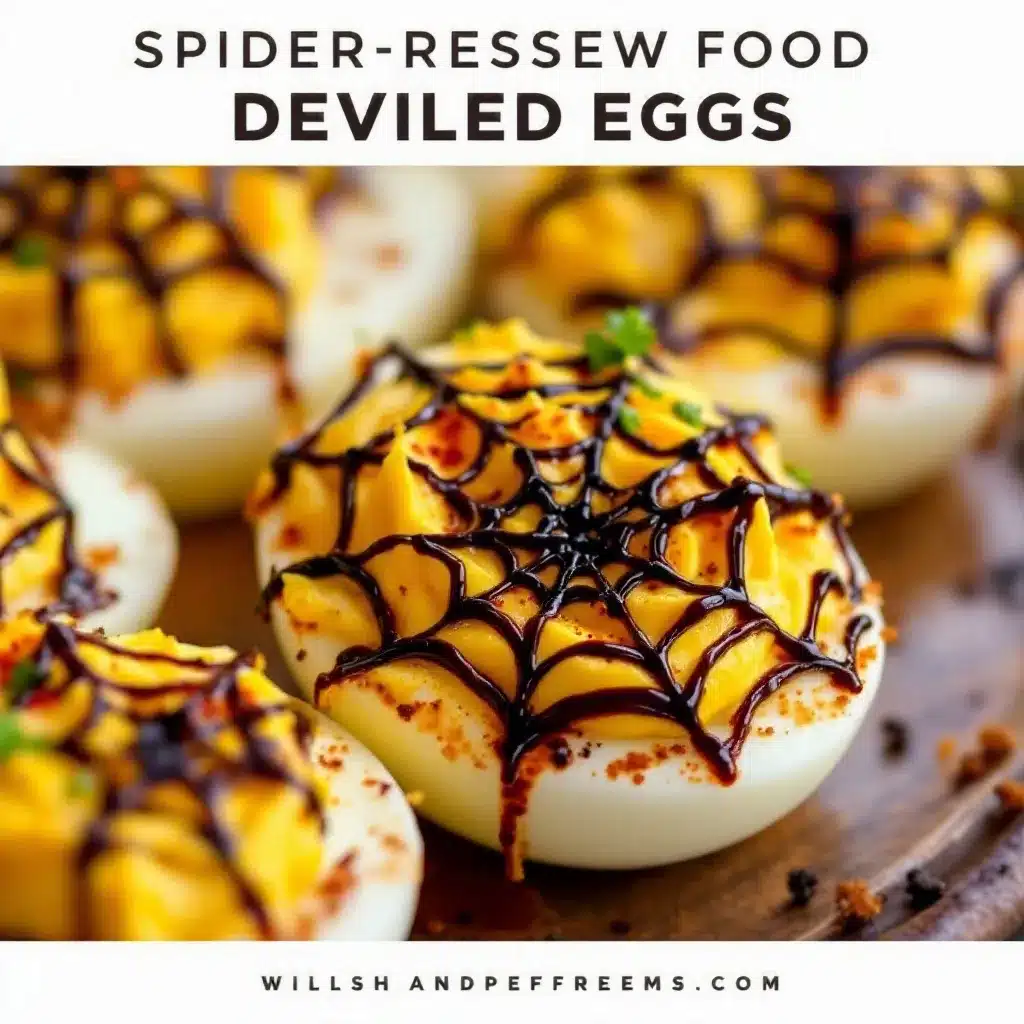
Here’s where the magic happens. Starting from the center of each filled egg white, pipe a small dot of the black mixture. Then pipe concentric circles around it—like a target. Don’t worry if they’re not perfect; the next step fixes everything.
Using a toothpick, gently drag from the center dot outward through all the circles, spacing the drags evenly around the egg. You should have about 6 to 8 drags. As you drag, the circles will pull into a web pattern. It’s almost instant—like magic. Wipe the toothpick clean between each egg to keep the lines sharp.
If you’re using black sesame seeds instead of food coloring, sprinkle a few seeds in the center of each egg to create a “spider” body, then pipe thin lines of plain mayonnaise radiating outward to suggest the web.
Step 7: Garnish and Serve
Lightly dust the filled eggs with paprika. You can also add a tiny spider decoration on top if you’re feeling extra—a raisin, a small olive slice, or a candy spider from the store. Arrange the eggs on your platter and serve immediately, or refrigerate until ready to serve.
These are best served cold, so keep them chilled until the last minute. If you’re making them ahead, cover the platter tightly with plastic wrap and refrigerate for up to 8 hours.
Cooking Tips & Techniques
I’ve made these spider web deviled eggs more times than I can count, and I’ve learned a few things the hard way. Let me save you the trouble.
The peeling struggle is real. If your eggs refuse to peel cleanly, you’re not alone. The trick is using older eggs (a week or two old) and shocking them in an ice bath immediately after boiling. I’ve also had good luck adding a teaspoon of baking soda to the boiling water—it raises the pH and makes the shells slip off easier.
Don’t overmix the filling. It’s tempting to keep stirring until it’s perfectly smooth, but overmixing can make the filling gummy. Mash it just until it’s combined and creamy. A few tiny lumps are fine—they’ll disappear when you pipe it.
Practice the spider web on wax paper first. I learned this after ruining three perfect egg halves. Pipe a few practice webs on a piece of wax paper or a plate before you touch the eggs. It takes two tries to get the pressure and spacing right. Trust me on this one.
Keep the black mixture thick. If the black mayo mixture is too thin, it’ll spread into a blob instead of staying in clean lines. Aim for the consistency of toothpaste. If it’s too runny, add more mayonnaise. Too thick, add a drop of water.
Work in batches. Don’t try to pipe the spider web design on all 24 egg halves at once. Pipe the filling on half of them, do the spider web design, then move on to the next batch. This keeps the filling from drying out and gives you a chance to adjust your technique as you go.
Temperature matters. Cold eggs are easier to fill and decorate. If your filling gets too warm while you’re working, pop it in the fridge for 5 minutes. Warm filling can make the spider web lines blurry.
Don’t skip the toothpick drag. This is what turns a simple circle pattern into an actual spider web. The drag pulls the concentric circles outward, creating those weblike connections. Wipe the toothpick clean after each egg or the black mixture will smear.
Variations & Adaptations
One of the best things about this recipe is how easy it is to adapt. Here are some variations I’ve tried and loved:
Spicy Southwest Spider Webs
Add 1/4 teaspoon of cayenne pepper and 1 tablespoon of finely chopped pickled jalapeños to the filling. The heat cuts through the richness beautifully. Top with a tiny slice of jalapeño instead of paprika. This version is always a hit at adult parties.
Herby Garden Webs
Mix 2 tablespoons of finely chopped fresh dill and 1 tablespoon of chopped chives into the filling. Use fresh parsley instead of paprika for garnish. The herbs give a fresh, bright flavor that pairs perfectly with the creamy filling. This is my go-to for spring gatherings, but it works for Halloween too.
Bacon-Lover’s Spider Webs
Crumble 4 strips of crispy bacon and mix half into the filling. Sprinkle the remaining bacon on top of the finished eggs before serving. The smoky, salty crunch takes these to a whole new level. I’ve made these for non-Halloween parties and they disappear just as fast.
Vegan Spider Web Deviled Eggs
Use firm tofu instead of egg yolks. Mash the tofu with black salt (kala namak) for that eggy flavor, plus vegan mayonnaise, mustard, and vinegar. The texture won’t be exactly the same, but it’s surprisingly close. I’ve served these to vegan friends and they were thrilled.
Gluten-Free Note
This recipe is naturally gluten-free, so no adaptations needed. Just double-check your mustard and mayonnaise labels to be sure.
Different Spider Web Colors
Who says spider webs have to be black? Use red food coloring for a bloody web, green for a creepy alien vibe, or purple for a magical Halloween look. I’ve done rainbow webs for a kids’ party and they loved it.
Serving & Storage Suggestions
These spider web deviled eggs are best served cold, straight from the refrigerator. Arrange them on a flat platter in a single layer so the spider web design is visible. I like to use a black platter for maximum spooky effect—the contrast makes the webs pop.
For a Halloween party spread, pair them with other finger foods like Mediterranean stuffed mini peppers for a colorful, crowd-friendly table. The creamy eggs balance nicely with the bright, tangy peppers. I also love serving them alongside a refreshing cucumber mint green tea cooler for a non-alcoholic option that cuts through the richness.
If you’re planning a full Halloween menu, these eggs work beautifully as a starter before a main course like slow cooker honey garlic chicken. The sweet-savory chicken is a great contrast to the tangy eggs.
Storage: Leftover deviled eggs can be stored in an airtight container in the refrigerator for up to 2 days. The spider web design may blur slightly as the eggs sit, so they’re best eaten the same day. If you’re making them ahead, prepare the filling and egg whites separately, then assemble and decorate within 2 hours of serving.
Reheating: Don’t. Deviled eggs are served cold. If they’ve been sitting out for more than 2 hours, discard any leftovers.
Flavor development: The filling actually gets better after a few hours in the fridge. The flavors meld together, and the texture firms up slightly. If you can make the filling a day ahead, do it.
Nutritional Information & Benefits
Here’s the nutritional breakdown per serving (2 egg halves):
| Nutrient | Amount |
|---|---|
| Calories | 140 |
| Protein | 8g |
| Fat | 11g |
| Saturated Fat | 2.5g |
| Carbohydrates | 1g |
| Fiber | 0g |
| Sugar | 0.5g |
| Sodium | 220mg |
Eggs are a fantastic source of high-quality protein and contain all nine essential amino acids. They’re also rich in choline, which supports brain health, and lutein and zeaxanthin, which are good for your eyes. The mayonnaise adds healthy fats that help your body absorb fat-soluble vitamins.
This recipe is naturally low in carbohydrates, making it suitable for low-carb and keto diets. It’s also gluten-free and can be made dairy-free by using a dairy-free mayonnaise. If you’re watching your sodium, use low-sodium mayonnaise and go easy on the salt.
One thing I appreciate about this recipe is that it feels indulgent without being over-the-top. You get the creamy, satisfying experience of a classic deviled egg, but with a fun Halloween twist that makes it special. It’s comfort food that happens to be pretty good for you.
Conclusion
These Spooky Spider Web Deviled Eggs are the Halloween appetizer you didn’t know you needed. They’re easy enough for a weeknight, impressive enough for a party, and delicious enough that people will ask for the recipe before they even finish eating.
What I love most about this recipe is how it turns a simple, everyday dish into something magical. You take the same deviled eggs you’ve been making for years, add a tiny bit of creativity, and suddenly they’re the star of the Halloween spread. No fancy ingredients, no complicated techniques—just a little patience and a fun idea.
I’d love to see how yours turn out! Tag me in your photos, leave a comment below, or share your own spider web variations. Did you try a different color? Add bacon? Make them vegan? Tell me all about it. And if you’re looking for more Halloween inspiration, check out our full recipe collection for more spooky ideas.
Now go make some spider webs—and don’t forget to save one for yourself before the crowd descends!
Frequently Asked Questions
Can I make these spider web deviled eggs ahead of time?
Yes! You can hard-boil and peel the eggs up to 3 days in advance. The filling can be made 1 day ahead and stored in a piping bag in the fridge. Assemble and decorate within 2 hours of serving for the best-looking spider webs.
What if I don’t have black food coloring?
No problem! Use black sesame seeds instead. Sprinkle a few in the center of each egg to create a “spider” body, then pipe thin lines of plain mayonnaise radiating outward. It looks different but equally cool, and it’s completely natural.
How do I get the eggs to peel easily?
Use eggs that are at least a week old (fresher eggs are harder to peel). Boil them, then immediately transfer to an ice bath for 5 minutes. Peel under running cold water. Adding a teaspoon of baking soda to the boiling water also helps.
Can I use a different filling recipe?
Absolutely! The spider web design works with any deviled egg filling. Try adding bacon, herbs, hot sauce, or even avocado for a green filling. Just make sure the black spider web mixture is thick enough to hold its shape.
How long do these last at a party?
Deviled eggs should not sit out at room temperature for more than 2 hours. If you’re serving them at a party, keep the platter on ice or serve in small batches, replenishing from the refrigerator as needed. They’re best eaten within 4 hours of preparation.
Pin This Recipe!
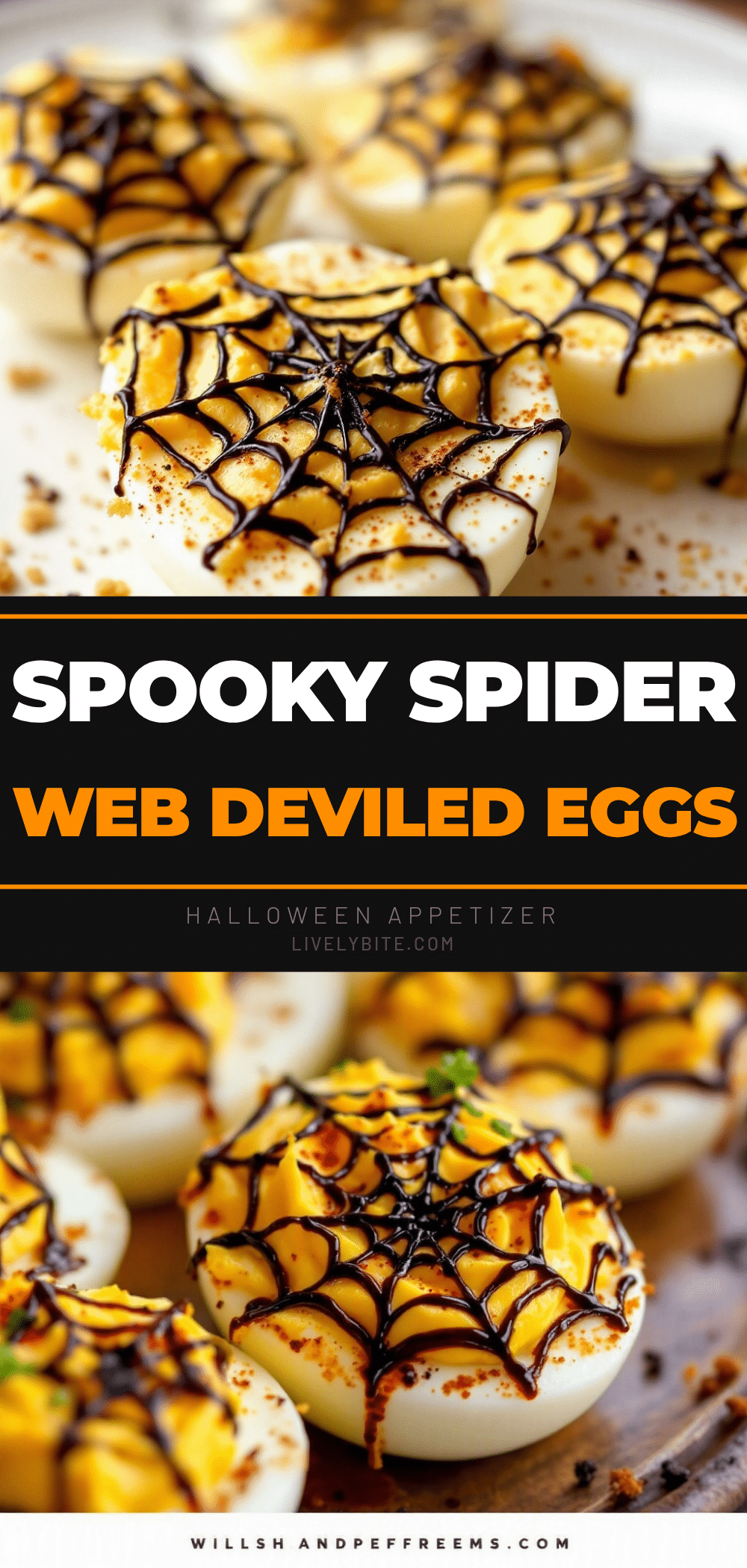
Spooky Spider Web Deviled Eggs: Easy Halloween Appetizer
These spooky spider web deviled eggs are a fun and easy Halloween appetizer that looks impressive but uses simple ingredients. The creamy filling is topped with a black spider web design made from mayonnaise and food coloring, creating a creepy-cute treat that disappears fast.
- Prep Time: 15 minutes
- Cook Time: 12 minutes
- Total Time: 27 minutes
- Yield: 24 servings 1x
- Category: Appetizer
- Cuisine: American
Ingredients
- 12 large eggs
- 1/2 cup mayonnaise
- 2 tablespoons yellow mustard
- 1 tablespoon white vinegar
- 1/4 teaspoon salt
- 1/8 teaspoon black pepper
- Paprika for garnish
- Black food coloring or black sesame seeds
Instructions
- Place 12 large eggs in a single layer in a large pot. Cover with cold water by about an inch. Bring to a rolling boil over high heat, then remove from heat, cover, and let sit for exactly 12 minutes.
- Prepare an ice bath. Transfer eggs to ice bath and let cool completely, about 5 minutes.
- Gently crack eggs and peel under running cold water. Pat dry. Slice each egg lengthwise in half. Pop out yolks into a medium bowl. Arrange egg white halves on serving platter, cut-side up.
- Add mayonnaise, yellow mustard, white vinegar, salt, and black pepper to the yolks. Mash together until smooth and creamy. Adjust seasoning to taste.
- Spoon filling into a piping bag fitted with a star tip (or a zip-top bag with corner snipped). Pipe filling into each egg white half, mounding slightly above the edge.
- In a small bowl, mix about 2 tablespoons of the remaining filling (or plain mayonnaise) with black food coloring gel until deep black. Spoon into a small piping bag with a tiny round tip (or zip-top bag with very small corner snipped).
- Starting from the center of each filled egg, pipe a small dot of black mixture. Pipe concentric circles around it. Using a toothpick, gently drag from the center dot outward through all circles, spacing drags evenly (about 6 to 8 drags). Wipe toothpick clean between eggs.
- Lightly dust filled eggs with paprika. Serve immediately or refrigerate until ready to serve.
Notes
Use older eggs (a week or two old) for easier peeling. Add a teaspoon of baking soda to the boiling water to help shells slip off. Practice the spider web design on wax paper first. Keep the black mixture thick (toothpaste consistency) for clean lines. Work in batches to prevent filling from drying out. Serve cold; do not leave at room temperature for more than 2 hours.
Nutrition
- Serving Size: 2 egg halves
- Calories: 140
- Sugar: 0.5
- Sodium: 220
- Fat: 11
- Saturated Fat: 2.5
- Carbohydrates: 1
- Protein: 8
Keywords: Halloween appetizer, deviled eggs, spider web, spooky, easy, party food, eggs